


The Man Who Owned No Land, But Gave Us Ours: A Review of the Krumbiegel Commemoration at NGMA

Updated: May 23
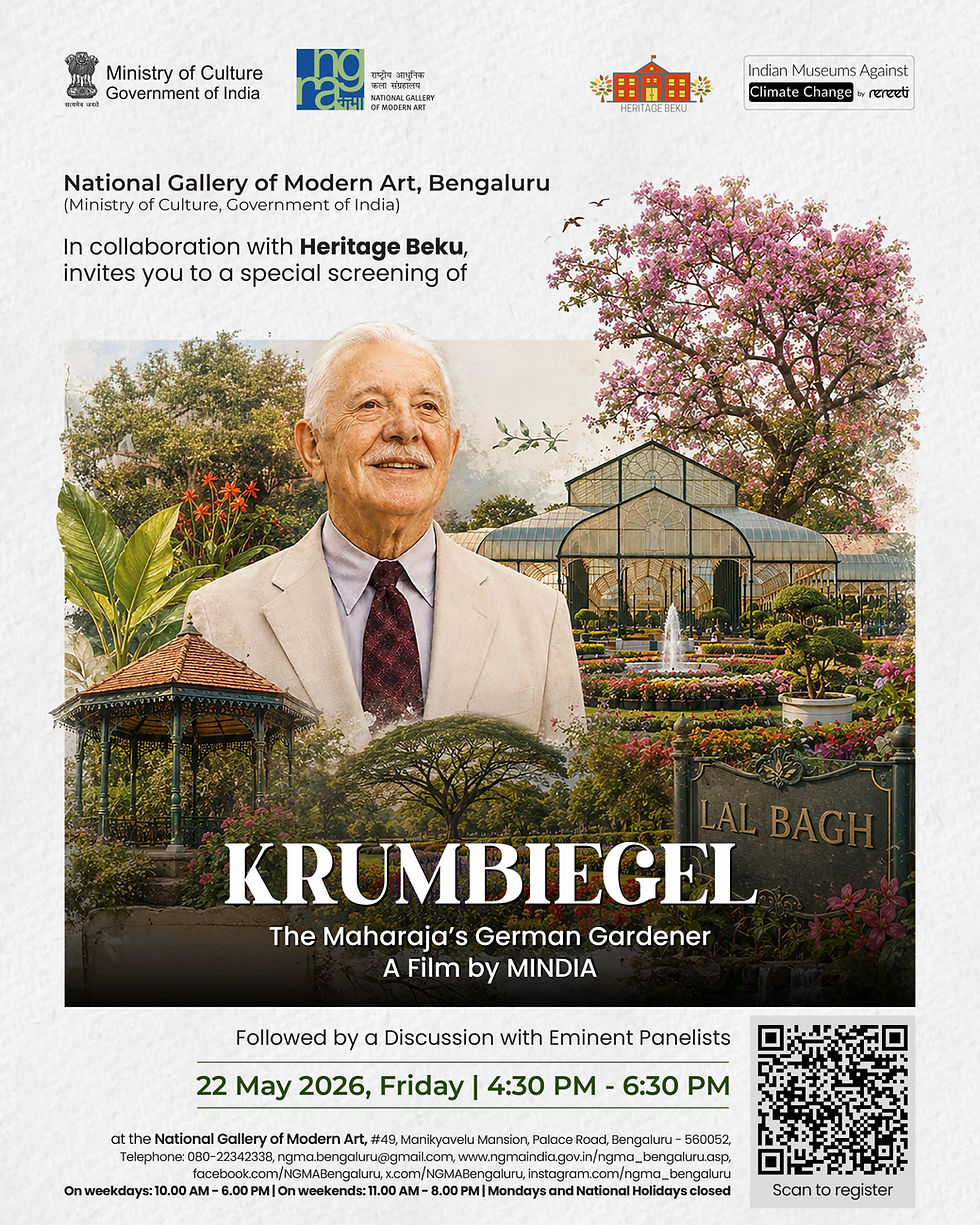
The Man Who Owned No Land, But Gave Us Ours: A Review of the Krumbiegel Commemoration at NGMA
The National Gallery of Modern Art (NGMA) auditorium in Bengaluru did not merely reach capacity; it overflowed.
By the time the lights dimmed for the screening of Ganesh Shankar Raj’s documentary, The Maharaja’s German Gardener, the room was bursting. An additional 30 to 40 chairs lined the aisles, and every deep bay window was occupied by citizens perched to get a glimpse.

This massive turnout was the first profound realization of the evening: generations later, Bengaluru still shows up for its green heritage. Watching the livestream from afar, Gustav Hermann Krumbiegel’s great-granddaughter, Alyia Krumbiegel—who carries her ancestor’s torch with fierce devotion—shared her deep emotion:
"Tonight’s screening for my great grandfather in Bangalore has left me deeply emotional. I was quietly worried not many people would come, and to see a full room, with people gathering in every corner just to listen and remember, means more than I can ever put into words. A legacy only truly lives on when people still care enough to show up for it generations later. Tonight, Bangalore did. 🌿 Thank you."
From Kew to Karnataka: The Visionary We Took for Granted
Organized by Heritage Beku, the Friday evening of 22 May 2026 masterfully bridged the gap between historical gratitude and urgent, future-forward civic action. The documentary traceed the staggering journey of a 19-year-old German youth who traveled from the Royal Botanic Gardens at Kew to Baroda, and finally to the red soil of Mysore and Bangalore.
We often view Krumbiegel through a purely botanical lens, but the film and subsequent panel discussion shattered that narrow view. GHK was an urban planner, an economist, and a humanitarian. Long before modern governance structures existed, he was installing farmers' ponds, establishing sustainable fisheries, and creating localized economic security for rural communities. He introduced agricultural diversity as a precursor to the very technological, gender, and economic diversity that defines Bengaluru as a global hub today.
Furthermore, as NGMA Director Priyanka Francis noted in her closing thanks, many in the room were astonished to learn the sheer breadth of his architectural and landscaping footprint—including his design contributions to iconic civic landmarks like the BBMP building and Jayanagar's Janatha Bazaar.
The Poignancy of an Outsider’s Devotion
Yet, for a man who orchestrated the symphonic, multi-colored canopy of our city, the true history of his final years left the auditorium in a heavy, collective silence.
Despite his deep reverence for local royalty and Indian citizens, geopolitical tides were cruel to Krumbiegel. He was interned as an "enemy alien" during both World Wars simply for his German birth. To the British, he was the Maharaja’s man; to the changing landscape of post-Independence India, he was a disposable relic of an old order.
When his formal tenure ended, this visionary was unceremoniously bundled into a small outhouse at Jayamahal Palace. Though his letters always proudly listed his address as Lalbagh—his true crowning jewel—he found himself in a brand-new country (Independent India) building itself from the bottom up, with no official place for him. He was given a heartbreaking two-day marching order to vacate and return to Germany, prompting a sorrowful final letter to his close friend, the Diwan of Mysore.
He stayed, and when he passed away at 90, he was laid to rest in a small, largely unmarked grave in the Indian Christian Cemetery on Hosur Road—just one of a hundred weathering headstones. Shortly after, his grieving wife Clara was given 2 days notice to vacate their quarters; she suffered a fatal stroke upon reaching England.
It is a profound, tragic irony: the man who designed the very identity of Bengaluru owned no land of his own within it. He was owned by no one . Not Germany which he left at 18, or Britain where he devoted 10 years at Kew (and married a British wife Clara) before coming in to Varoda and India at 28. He lived on an annual salary of just ₹600, remaining a legal outsider in every space he radically transformed.
The Panel: Turning Memory into Momentum
Following the film, the panel discussion dynamically connected this historical debt to concrete plans for Bengaluru’s ecological survival. There was a moment of silence remembering the selfless man and brilliant visionary -with no country- who gave us our city of joy.
1. Mr. R. Girish, IAS (Secretary of Horticulture) on Policy & Green Corridors
Mr. Girish brought administrative reality to the stage, suggesting the structural implementation of dedicated green corridors to combat growing urban heat islands.
The discussion shifted to the urgent need to overhaul municipal policy. A major loophole was spotlighted: the current system allows for online tree-cutting applications, and penalties for illegal felling are often compoundable (settlable with a minor fine). The panel and audience strongly advocated for making tree-cutting penalties non-compoundable, carrying mandatory prison time. Tightening these legal screws is the only way to deter illegal felling by commercial developers.
2. Suresh Jayaram (Art Historian & Author) on Historical Truth
Suresh grounded the conversation in the artistic genius of Krumbiegel’s "serial blossom"—the intentional choreography of flowering trees so the city changes color season by season.
He also brought a moment of witty relief to the room. When an audience member joked that the spelling on "Krumbiegel Road" is notoriously botched by city municipal workers, a panelist quipped that many locals genuinely believe "Krumbiegel" is a native name from North Karnataka. The consensus? Perhaps we should leave the spelling mistakes alone and let North Karnataka proudly claim him too!
3. Ganesh Shankar Raj (Filmmaker) on Educational Connects
Ganesh emphasized that the film must not stop at cultural auditoriums. He laid out plans to take the documentary directly into schools and colleges to foster an emotional, ecological connection within the younger generation.
The audience enthusiastically backed this, calling for a major youth outreach push ahead of Krumbiegel’s birthday this December.
Reclaiming the Space: The Revival of Traffic-Free Cubbon Park
The energy in the room turned fiercely proactive when discussing Bengaluru’s immediate environmental future. The audience collectively demanded a revival of Heritage Beku’s highly successful campaign for a Traffic-Free Cubbon Park.
While the initiative previously faced pushback from the traffic department, the overwhelming consensus at NGMA was clear: it is time to push back harder. Protecting these historic green lungs from vehicle emissions is no longer an option; it is a necessity to lower the city's worsening microclimate temperatures.
The Manifesto: Giving Him Ownership
We breathe the oxygen his avenue trees multiplied. We walk beneath the explosion of canopies he imported like precious cargo from the far corners of the earth.
It is a historical injustice that G.H. Krumbiegel remains an unrecognized force. A misspelled street sign is not enough. A single statue is not enough.
Heritage Beku proposes three definitive steps to level the scales:
The Posthumous Honorary Citizenship: A formal, symbolic declaration by the State of Karnataka to claim G.H. Krumbiegel as a true son of the soil.
The Krumbiegel Memorial Bust: An artistic installation at the heart of his landscape to serve as an interactive educational space for children.
The Annual Krumbiegel Legacy Award: To honor local communities, lake-groups, and young climate warriors who preserve our urban canopy.
When he died, he had no country to call his own. It is time we change that. We have owned his work for a century; it is finally time to let him own us. Let us give him the ultimate, permanent goodbye: the status of a true, honored Bangalorean.
"In the end, we will conserve only what we love; we will love only what we understand; and we will understand only what we are taught."
— Baba Dioum
Let us teach our children who designed the Garden City, so they find the courage to save it. Bengaluru Beku—and our green heritage starts with us.
Comments